spiral roll 2

English Breakfast Spiral Roll Sushi

The November 2009 Daring Cooks challenge was brought to you by Audax of Audax Artifex and Rose of The Bite Me Kitchen. They chose sushi as the challenge.

Forget the dried tasteless stuff you find in the supermarket, nothing beats freshly made sushi, it’s delicious! I decided to experiment with my sushi fillings and came up with some untraditional combinations.

First up were dragon/caterpillar rolls. I couldn’t get my hands on barbequed eel so I used goose & smoked salmon for my fillings. The classic combination of goose & plum worked well, as did the smoked salmon & chicory. However I need to work on my rolling technique as they were on the loose side so fell apart.

sushi dragon roll1

Goose filling & caramelized plum Dragonpillar Roll

sushi dragon roll2

Smoked salmon & cucumber filling, chicory & red onion Dragonpillar Roll

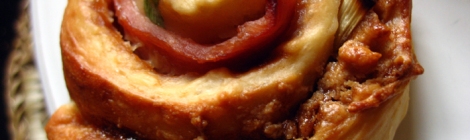
Secondly I made my spiral roll. I love playing around with different cultural cuisines so decided to incorporate the English Breakfast into my sushi. I used fried egg, sausage, tomato, mushroom, peas, baked beans. This was exciting and tasted great, my favorite of all the sushi I made.

spiral roll 3

Fried egg, tomato, baked beans, sausage,mushroom & peas

spiral roll 1

English Breakfast Spiral Sushi Roll

Finally I made Maki rolls. I went for a sweeter theme to this, using figs, pumpkin, beetroot, apple, sweetcorn & cream cheese. I used a mixture of black sticky rice as well as sushi rice for a two-toned effect. Unfortunately I ran out of time & rice to make the nigiri sushi in time for the posting date.

maki sushi1

Maki Sushi Rolls

maki sushi3

Cream cheese, chive & fig Maki Roll

maki sushi4

Black sticky rice & Pumpkin Maki Roll

PART 1 : SUSHI RICE (makes about 7 cups of cooked sushi rice)

Preparation time: 1¾ hours consisting of :-
Rinsing and draining rice: 35 minutes
Soaking rice: 30 minutes (includes 5 minutes making the vinegar dressing)
Cooking and steaming time: 25 minutes
Finishing the rice: 15 minutes

INGREDIENTS:

2½ cups uncooked short grain rice

2½ cups water

For superior results use equal volumes of rice and water

Optional Ingredients

3 inch (75mm or 15 grams) square dashi konbu (or kombu) (dried kelp seaweed) wipe with a damp cloth to remove white powder & cut a few slits in the sides of the kelp to help release its flavours

2½ teaspoons (12.5 mls) of sake (Japanese rice wine)

Sushi vinegar dressing

5 Tablespoons (75 mls) rice vinegar

5 Teaspoons (25 mls or 21 grams) sugar

1¼ Teaspoons (6.25 mls or 4.5 grams) salt

DIRECTIONS:
Rinsing and draining the rice

Swirl rice gently in a bowl of water, drain, repeat 3-4 times until water is nearly clear. Don’t crush the rice in your hands or against the side of the bowl since dry rice is very brittle.

Gently place rice into a strainer and drain well for 30 minutes.

Soaking the rice

Gently place the rice into a heavy medium pot with a tight fitting lid (if you have a loose fitting lid use a piece of aluminium foil to make the seal tight).

Add 2½ cups of water and the dashi konbu.

Set the rice aside to soak for 30 minutes, during this time prepare the sushi rice dressing.

Preparing the Rice Vinegar Dressing

Combine the rice vinegar, sugar and salt in a small bowl.

Heat on low setting.

Stir until the mixture goes clear and the sugar and salt have dissolved.

Set aside at room temperature until the rice is cooked.

Cooking the rice

After 30 minutes of soaking add sake (if using) to the rice.

Bring rinsed and soaked rice to the boil.

Reduce heat to the lowest setting and simmer, covered, until all the water is absorbed, 12-15 minutes. Do not remove the lid during this process. Turn off heat.

Let stand with the lid on, 10-15 minutes. Do not peek inside the pot or remove the lid. During this time the rice is steaming which completes the cooking process.

Finishing the rice

Turning out the rice

Moisten lightly a flat thin wooden spatula or spoon and a large shallow flat-bottomed non-metallic (plastic, glass or wood) bowl. Do not use metallic objects since the vinegar will react with it and produce sour and bitter sushi rice.

Remove the dashi konbu (kelp) from the cooked rice.

Use the spatula to loosen gently the rice and invert the rice pot over the bowl, gently causing the cooked rice to fall into the bowl in one central heap. Do this gently so as not to cause the rice grains to become damaged.

Dressing the rice with vinegar

Slowly pour the cooled sushi vinegar over the spatula onto the hot rice.

Using the spatula gently spread the rice into a thin, even layer using a 45° cutting action to break up any lumps and to separate the rice. Don’t stir or mash rice.

After the rice is spread out, start turning it over gently, in small portions, using a cutting action, allowing steam to escape, for about a minute.

Fanning & Tossing the rice

Continue turning over the rice, but now start fanning (using a piece of stiff cardboard) the rice vigorously as you do so. Don’t flip the rice into the air but continue to gently slice, lift and turn the rice occasionally, for 10 minutes. Cooling the rice using a fan gives good flavour, texture and a high-gloss sheen to the rice. The vinegar dressing will be absorbed by the hot rice. Using a small electric fan on the lowest speed setting is highly recommended.

Stop fanning when there’s no more visible steam, and all the vinegar dressing has been adsorbed and the rice is shiny. Your sushi rice is ready to be used.

Keeping the rice moist

Cover with a damp, lint free cloth to prevent the rice from drying out while preparing your sushi meal. Do not store sushi rice in the refrigerator leave on the counter covered at room temperature. Sushi rice is best used when it is at room temperature.

* Tip: To make sushi rice: for each cup of rice use 1 cup of water, 2 Tbs rice vinegar, 2 tsp sugar, ½ tsp salt and 1 tsp sake. For superior results use equal volumes of rice and water when cooking the sushi rice since the weight of rice can vary. Weight of 2½ cups of uncooked rice is about 525 grams or 18½ ounces.

* Tip: While the rice is draining, soaking and cooking prepare your rice vinegar dressing, sushi fillings and toppings.

* Tip: Photo series on How to Cook Rice with a Pot
http://www.sushiencyclopedia.com/how_to_make_sushi/how_to_cook_rice_with…

* Tip: Photo series on How to Make Sushi Rice with Tools You Already Own
http://www.sushiencyclopedia.com/how_to_make_sushi/how_to_make_sushi_ric…

NOTES:
Sushi Rice – choose a short or medium grain rice. Do not use Arborio, long-grain, or parboiled white rice. Medium-grained calrose is a suitable rice. Rice expands (about 3 times) when cooked so make sure your pot is large enough. Washing the rice removes the rice flour that coats the rice and gives a fresh flavour and scent to the cooked rice. Look for rice that is labelled ’sushi’ rice. Cooked sushi rice can be placed in plastic bags and frozen for 3 months, microwave when needed. Cooked sushi rice should be sticky, shiny and the individual grains of rice can been see. Price: AUS $4/KG.

Dashi konbu – or ( dashi kombu) – dried kelp, it looks like broad, leathery, wrinkly greenish ribbon often coated with a white powder. The darker green the leaves, the better the quality of kelp. Dashi konbu adds a refreshing light ocean taste to sushi rice. Price: AUS $1.50 for ten 3”(75mm) squares.

Rice Vinegar – this gives prepared sushi rice its unique clean, crisp taste. Do not use bottled “sushi vinegar” as it is too harsh and has a bitter after-taste. Look carefully at the label of the rice vinegar it should have NO SALT and NO SUGAR in the product. Apple cider vinegar is a good substitute if rice vinegar is not available. You can use mild white wine vinegar or mild red wine vinegar if you cannot find rice vinegar or apple cider vinegar. DO NOT USE NORMAL WHITE VINEGAR it is too harsh. Price: AUS $4 /500ml bottle.

Sake – Japanese rice wine. Do not use cooking sake or Chinese cooking rice wine, look for a reasonably priced drinkable sake. Refrigerate opened sake & use within two months. You can use vodka or a mild tasting gin if sake is not available. Price: AUS $10/500ml bottle.

Sugar – you can use mild honey or any other vegan substitute to give the equivalent sweetness.

PART 2 : Dragon Rolls (also called Caterpillar Rolls)

Preparation time: 30 minutes, plus 1¾ hours to make the sushi rice
Cooking time: about 5 minutes (grilling the eel)

Yield: 2 inside-out (uramaki) sushi rolls

INGREDIENTS:

1 sheet 7”x8” (17.5cmx20cm) of toasted nori (dried seaweed sheets), cut into halves

1/2 Japanese cucumber

2 cups of prepared sushi rice

Glazed Barbecued Eel (ungai) (about 3½ ounces or 100 grams)

1 Avocado

Vinegared Water – ½ cup of water combined with a dash of rice vinegar

Various small amounts of sauces to use as the flames of the dragon (or legs of a caterpillar)

Optional

2 tablespoons (25 grams or 1 oz) Fish Roe (Fish eggs)

DIRECTIONS:
1.Cut cucumber into strips ¼ inch (6mm) x 7” (175mm) long, then salt, rinse & dry the strips.
2.Grill (broil) the eel for about 2-5 minutes until bubbling. Cut into two lengthwise strips.
3.Halve, pit and peel the avocado. Cut the avocado halves into thin even 1/8 inch (3 mm) slices. Fan out the cut avocado into a 7 inch (175 mm) overlapping pattern.
4.Cover bamboo mat with plastic wrap. Place a sheet of nori shiny side down, lengthwise, on the edge the mat.
5.Moisten lightly your hands in the bowl of vinegared water.
6.Place one cup of rice on the nori and gently rake your fingertips across grains to spread rice evenly. Do not mash or squash the rice onto the nori, the rice should appear loosely packed and be evenly distributed over the entire sheet, you should be able to see the nori sheet in a few places.
7.Flip the rice-covered nori over (so the bare nori is now on top) and place on the edge of the mat closest to you.
8.Arrange one of the eel strips across the length of the nori, not quite centred on it but a little closer to you. Place half the cucumber sticks next to the eel.
9.Lift the edge of the mat closest to you with both hands, keeping your fingertips over the fillings, and roll the mat and its contents until the edge of the mat touches straight down on the nori, enclosing the fillings completely. Lift up the edge of the mat you’re holding, and continue rolling the inside-out roll away from you until it’s sealed. Tug at the mat to tighten the seal. If the rice doesn’t quite close the roll add more rice in the gap and re-roll using the mat to completely cover the inside-out roll. Place the roll on a damp, clean smooth surface.
10.Spread about 1 tablespoon of the optional fish roe along the entire top of the rice-covered roll. Using the plastic covered mat gently press the fish roe so it adheres to the rice.
11.Slide a knife under one fan of avocado and transfer it onto the top of an inside-out roll. Gently spread out the avocado layer to cover the entire roll. Lay the plastic wrapped mat over the avocado-covered roll. Squeeze very gently to shape the roll.
12. Lay a sheet of plastic wrap over the roll. Slice the roll into 6-8 equal, bite-sized pieces, wiping your knife with a damp towel before each slice. Discard the plastic wrap. Repeat the above to make one more roll.
13.Arrange the cut pieces on a serving plate with the sauces so the finished dish appears as a dragon breathing fire and flames (or a caterpillar with many legs).

* Tip: The most common mistake is having too much filling the golden rule is less is more when it comes to making sushi it is easier to roll an under-filled roll than an over-filled roll.

* Tip: Dampen your knife with a moist lint-free towel before every cut – this prevents the sushi rice from sticking to your knife.

* Tip: Excellent videos on making Dragon Rolls
http://www.youtube.com/watch?v=pQZGRohVNFQ
http://www.youtube.com/watch?v=fo55iBN9FQs&feature=related

NOTES:
Bamboo mat (makisu) – A 10 inch (25cm) square mat made of thin slates of bamboo tied together with string.
Substitutes: a thin magazine cut to size wrapped in plastic wrap or a few layers of parchment paper cut to size about 10 inch (25cm) square.

Nori – Sheets of seaweed (laver) processed into thin sheets about 7 inches x 8 inches (17.5cm x 20cm) in size. Always re-toast the nori sheet over a gas stove on low flame for 5 to 10 seconds, or place nori on a clean oven rack and bake it in a preheated 350F-degree (180C) oven for 30 seconds. Nori should be sealed tightly in a plastic bag and used within a few months. It can be stored in the freezer. Nori will deteriorate if left out of its sealed package so use quickly.
Substitutes: Thin cooked egg omelette cut to same size as a nori sheet (7 inches by 8 inches or 17.5cm x 20cm). Also soya bean wrappers, rice paper, tofu wrappers, dosas, crepes or an overlapping layer of thinly sliced cooked vegetables.

Glazed Freshwater Barbecued Eel (unagi) – Deliciously rich and a little like pork they are sold in packs in the freezer (and sometimes the fresh fish) section of Asian markets.
Substitutes: Teriyaki chicken, cooked crab meat, smoked fish, smoked chicken, seared beef with BBQ sauce, deep fried tofu with dark soya sauce, tinned pink or red salmon, smoked salmon, fresh cooked soy beans with a selection of dark sauces, caramelized onions, firm cream cheese, or extra avocado with BBQ sauce as the filling. Any remaining eel should be left in the package re-wrapped in plastic and returned to the freezer as quickly as possible.

Japanese Cucumber – Japanese cucumbers are thin-skinned, seedless and contain much less water than normal cucumber.
Substitutes: English or hothouse cucumbers which have been peeled, de-seeded and salted as above. If not available try matchsticks of your favourite crisp vegetable.

Avocado
Substitutes: If not available use slices of roasted capsicum (bell pepper), slices of roasted tomatoes, lightly cooked whole snap (snow) peas, slices of Japanese daikon radish or other cooked thinly sliced vegetables, or slices of ’sushi’ grade fish such as tuna, yellow tail and red snapper; smoked salmon, pastrami, salami, various colours of fish roe, or various colours of sesame seeds.

Fish Roe (Fish eggs or caviar) – most roes (fish eggs) are rich so they are served in small portions. Try salmon roe (ikura), smelt roe (masago) or seasoned flying-fish roe (tobiko).
Substitutes: You can use toasted sesame seeds or black onion (nigella) seeds as a vegan choice.

PART 3 : Spiral Sushi Roll
This is easiest ‘decorative’ sushi roll.

Preparation time: 15 minutes, plus 1¾ hours to make the sushi rice

Yield: One Roll, cut into 8 pieces

INGREDIENTS:

2½ cups prepared sushi rice

2 sheets of toasted nori, each sized 7”x8” (17.5cmx20cm)

Six assorted fillings, each filling should be the size of a pencil (see note below)

DIRECTIONS:
1.Join 2 sheets of nori by moistening the adjacent edges and overlapping them about ½ inch (12mm).
2.Place this double sheet shiny side down on a rolling mat, part of the nori will extend beyond the mat.
3.Using moist fingers place 2½ cups of rice on the nori and gently rake your fingertips across grains to spread rice evenly, leaving ¼ inch (6mm) nori showing on the both ends of the sheet. Do not mash or squash the rice onto the nori, the rice should appear loosely packed and be evenly distributed over the entire sheet, you should be able to see the nori sheet in a few places.
4.Using your fingers form six grooves (in the same direction that you will be rolling the mat) at even intervals across the bed of rice. Make the first groove about 2 inches (50 mm) from the edge of the nori sheet. Form the grooves by pushing the rice away, do not mash or squash the rice, leave a loose one grain layer of rice in the bottom of the grooves. Level the areas between the grooves where you have pushed the rice.
5.Place your fillings in the grooves. Fill the grooves a little higher than the surrounding rice bed.
6.Then roll the sushi up from the edge closest to you, this will form a spiral pattern of nori, rice and fillings inside the roll.
7.Slice into 8 pieces with a very sharp wet knife, wiping the blade with a damp cloth after each cut.
8.Place the pieces on a platter and garnish.

NOTE:
Make each groove about a finger-width wide they will hold about 1-2 tablespoons of filling. Use fillings that compliment each other and are highly coloured. Use parboiled vegetables cut into strips, seafood, left over eel, smoked fish or chicken, whole cooked beans, edible flowers etc….

PART 4 : Nigiri Sushi
Nigiri sushi is the type of sushi most often made in sushi bars. In Japanese, nigiri means “squeeze”.

Preparation time: 30 minutes, plus 1¾ hours to make the sushi rice

Yield: 14-16 pieces of sushi

INGREDIENTS:

2 cups prepared sushi rice

8 pairs of assorted toppings, 200 gms/7 ozs total of fish, meat or vegetables (see note below)

1 tablespoon Wasabi (paste, reconstituted powder) or any other paste to adhere topping to rice

Optional

Garnishes such as Ginger (pickled), chilli strips, vegetables flowers etc

Thin strips of nori or vegetables (for tying topping on)

DIRECTIONS:
1.When handling sushi rice, make certain your hands are very clean. To keep the rice from sticking to our hands moisten your hands with vinegared water.
2.Form nigiri sushi by scooping up a small amount (about 2 tablespoons) of rice with your forefinger and second finger of your right hand and placing it in your cupped left palm.
3.Use the fingers and thumb of your right hand to form it into a long, narrow mound (about 2 inches x 1 inch wide or 50mm x 25mm) in your cupped palm.
4.Press enough to make the rice hold firmly together. Place the nigiri on a damp cutting board flat side down. Don’t let sushi touch or they’ll stick to each other. At this point, you can cover the sushi with plastic wrap, and they’ll keep at room temperature (not the refrigerator) for several hours.
5.Smear a thin line of wasabi on top of the rice and place the topping piece on it. You may need to press the topping down lightly with your fingers and adjust the shape of the rice accordingly to form an attractive piece of nigiri sushi. If your topping is very loose like fish roe you can place a strip of nori (higher than the rice) around the nigiri and form ‘battleship’ sushi. The cavity that the nori forms holds the topping so it does not fall off.
6.Garnish as desired and use strips of nori (or vegetable) to tie the topping to the nigiri if needed.
7.It is customary to make nigiri sushi in pairs, so make two of each variety.

* Tips: A great video on making nigiri sushi
http://www.howcast.com/videos/270-How-To-Make-Sushi
A great web page on slicing fish for nigiri
http://www.sushilinks.com/sushi-recipes/how-to-buy-fish/index.html

NOTES:
Seafood nigiri must use sushi grade (sashimi grade) fish. Try tuna, red sea bream (red snapper), yellowtail or salmon. Cooked shrimp, cooked crab, cooked meat can also be used! You can use any vegetable you wish try asparagus, pumpkin, carrot, avocado, cucumber, shiitake mushroom, tofu, thin sliced egg omelette, etc… Thinly slice or julienne vegetables, parboiling if necessary tie on with a thin (1/4” or 6mm) strip of nori or vegetable strip wrapped around the whole sushi if needed..

*MOST IMPORTANT ADVICE YOU MUST READ THIS* – If you are using raw fish or raw meat it must be ’sushi’ grade (sashimi grade) ask your fishmonger or butcher for advice and if in doubt don’t use. Find your local Japanese market and ask them where the best sushi (sashimi) fish is. Maybe you can buy sushi grade fish at your local sushi bar. Purchase flash-frozen sashimi grade fish which is guaranteed to be free of all parasites. Only salt-water fish and shellfish should be consumed raw. Crab and prawn (shrimp) should always be cooked. Sashimi grade fish should have a clean cool smell if it smells fishy it is a sign that the fish is old and cannot be used. If you are pregnant or have a weakened immune system only use cooked ingredients. There is no need to use raw fish or raw meat in sushi.

macaroon v3 1

carob, matcha & lemon, rose, lemongrass & mango flavoured macarons

The 2009 October Daring Bakers’ challenge was brought to us by Ami S. She chose macarons from Claudia Fleming’s The Last Course: The Desserts of Gramercy Tavern as the challenge recipe.

Macarons are by far the most alluring treat in the windows of French patisseries. Their cute roundness and bright colours have a magnetic effect on me. After drooling over images of beautiful macaroons on Tartlette’s blog, I was eager to get started. However simple the recipe appears to be, after 3 attempts I have still not managed to create the perfect macaron ;-(

Attempt no.1

macaroon v1 1

Matcha, sherbet & liquorice, carob, carrot

macaroon v1 2

violet, rose, hibiscus

A silly idea popped into my head that made me pour my macaron batter into silicon cupcake cases. The resulting macarons were rather moist and cakey, not macarony at all. My flavours were: rose, hibiscus, sherbet & liquorice, carob, violet, matcha, carrot (I used packet soup!). I filled these with flavoured butter cream but found them far too sickly. The most successful from this bunch were the hibiscus and the matcha which I filled with lemongrass butter cream.

Attempt no.2

macaroon v2 2

argh…..what ugly lumps!!!!!!!

I decided to experiment with using different nuts. Not having a food processor meant that this was rather time consuming. I made chestnut & hibiscus, brazil nut & purple yam & raspberry jam, crystallized ginger & sago, apple & cinnamon. This batch were extremely disappointing and flat! I think I made the batters too heavy. They tasted ok.

Attempt no.3

macaroon v3 2

Frustrated with this recipe I opted for a different source. The one I made had a higher icing sugar percentage. I had a hard time making these – managed to smash my pyrex mixing bowl and clumsily stuck my oven glove into a half baked macaron…grrrr! However, they grew feet in the oven & had a lovely glossy sheen.

My flavours were: carob, matcha & lemon, rose, lemongrass & mango. I decided against using artificial food colorings so opted for the natural alternative. I used turmeric to color the lemongrass & mango, and crushed up rose petals for a lovely pink macaron.  Instead of making butter cream, I filled my macarons with raspberry jam, marmalade, chestnut & pumpkin puree & sago. I also sandwiched some extra discs of edible paper. This was by far the most difficult DB challenge so far!

Macarons by Claudia Fleming’s The Last Course: The Desserts of Gramercy Tavern

Preparation time: Not taking into account the amount of time it takes for you to bring your egg whites to room temperature, the whole baking process, including making the batter, piping and baking will probably take you about an hour to an hour and a half. How long it takes to make your filling is dependent on what you choose to make.
Actual baking time: 12 minutes total, plus a few minutes to get your oven from 200°F to 375°F.
Ingredients
Confectioners’ (Icing) sugar: 2 ¼ cups (225 g, 8 oz.)
Almond flour: 2 cups (190 g, 6.7 oz.)
Granulated sugar: 2 tablespoons (25 g , .88 oz.)
Egg whites: 5 (Have at room temperature)
Directions:
1. Preheat the oven to 200°F (93°C). Combine the confectioners’ sugar and almond flour in a medium bowl. If grinding your own nuts, combine nuts and a cup of confectioners’ sugar in the bowl of a food processor and grind until nuts are very fine and powdery.
2. Beat the egg whites in the clean dry bowl of a stand mixer until they hold soft peaks. Slowly add the granulated sugar and beat until the mixture holds stiff peaks.
3. Sift a third of the almond flour mixture into the meringue and fold gently to combine. If you are planning on adding zest or other flavorings to the batter, now is the time. Sift in the remaining almond flour in two batches. Be gentle! Don’t overfold, but fully incorporate your ingredients.
4. Spoon the mixture into a pastry bag fitted with a plain half-inch tip (Ateco #806). You can also use a Ziploc bag with a corner cut off. It’s easiest to fill your bag if you stand it up in a tall glass and fold the top down before spooning in the batter.
5. Pipe one-inch-sized (2.5 cm) mounds of batter onto baking sheets lined with nonstick liners (or parchment paper).
6. Bake the macaroon for 5 minutes. Remove the pan from the oven and raise the temperature to 375°F (190°C). Once the oven is up to temperature, put the pans back in the oven and bake for an additional 7 to 8 minutes, or lightly colored.
7. Cool on a rack before filling.

I used the following recipe on my third attempt
1 egg whites at room temp
82g icing sugar
41g ground almonds
1. whisk the egg whites to form stiff peaks
2. in another bowl, combine the icing sugar and ground almonds
3. Take a large metal spoon and gently fold a third of the sugary almonds into the egg whites until smooth. Repeat until all the almonds are incorporated into the mixture.
4. carefully spoon the mixture into a piping bag with a plain nozzle (about 1cm size). Pipe into about 20 rounds about 2 cm in diameter, allowing a little space between each. Stand for about 5-10mins before baking.
5. Bake at 170c/ gas mark 3 for 20mins.
6. Allow to cool for 5-10mins before transferring onto a cooling rack. When completely cold, sandwich the macaroons together in pairs with your choice of fillings.

DC noodle pho

Squid Pho

DC sweet wonton3

Mincemeat wonton

The October 2009 Daring Cooks’ challenge was brought to us by Jaden of the blog Steamy Kitchen. The recipes are from her new cookbook, The Steamy Kitchen Cookbook.

For this months DC challenge I made a squid & kelp version of this delicious noodle dish. The simple yet effective roasting of the spices really brought out the aromas of this soup. I had a few disasters on my sweet wonton experiments – my first batch included lychee & black sesame wonton, bread & butter pudding wonton, marshmallow wonton. They weren’t the most suitable fillings & I made a mess when the marshmallow leaked into the hot oil. Lychee just didn’t go with the crispy wonton pastry, and the bread & butter pudding was far too dry. On my second attempt I made mincemeat wonton, pumpkin puree wonton, and marmalade  & tamarind baked wonton. I used a cookie cutter to stamp out shapes; these were prettier and tastier.

DC sweet wonton1

Pumpkin puree wonton

DC sweet wonton2

Marmalade & tamarind baked wonton

DC sweet wonton4

Not so sucessful: Lychee & black sesame wonton, bread & butter pudding wonton

DC sweet wonton5

Green marshmallow wonton

Challenge #1: Vietnamese Chicken Pho

Recipe Source: Jaden of Steamy Kitchen from her new book The Steamy Kitchen Cookbook.

Variations – Pho: chicken, beef, pork, seafood or vegetarian/vegan.

Preparation Time: 45 cooking time + 15 minutes to cook noodles based on package directions

Servings: Makes 4 servings

Ingredients:

For the Chicken Pho Broth:
2 tbsp. whole coriander seeds
4 whole cloves
2 whole star anise
2 quarts (2 liters/8 cups/64 fluid ounces) store-bought or homemade chicken stock
1 whole chicken breast (bone in or boneless)
½ onion
1 3-inch (7.5 cm) chunk of ginger, sliced and smashed with side of knife
1 to 2 tbsps. sugar
1 to 2 tbsps. fish sauce

1 lb. (500 grams/16 ounces) dried rice noodles (about ¼ inch/6 mm wide)

Accompaniments:
2 cups (200 grams/7 ounces) bean sprouts, washed and tails pinched off
Fresh cilantro (coriander) tops (leaves and tender stems)
½ cup (50 grams/approx. 2 ounces) shaved red onions
½ lime, cut into 4 wedges
Sriracha chili sauce
Hoisin sauce
Sliced fresh chili peppers of your choice

Directions:

1. To make the Chicken Pho Broth: heat a frying pan over medium heat. Add the coriander seeds, cloves and star anise and toast until fragrant, about 3-4 minutes. Immediately spoon out the spices to avoid burning.
2. In a large pot, add all the ingredients (including the toasted spices) and bring to a boil.
3. Reduce the heat to medium-low and let simmer for 20 minutes, skimming the surface frequently.
4. Use tongs to remove the chicken breasts and shred the meat with your fingers, discarding the bone if you have used bone-in breasts.
5. Taste the broth and add more fish sauce or sugar, if needed. Strain the broth and discard the solids.
6. Prepare the noodles as per directions on the package.
7. Ladle the broth into bowls. Then divide the shredded chicken breast and the soft noodles evenly into each bowl.
8. Have the accompaniments spread out on the table. Each person can customize their own bowl with these ingredients.

Challenge #2: Chocolate Wontons

Recipe Source: Jaden of Steamy Kitchen from her new book The Steamy Kitchen Cookbook.

Posting Date: October 14, 2009

Preparation time: 15 minutes + 15 minutes cooking time (for 12 wontons)

Servings: Makes 12 wontons.

Ingredients:

1 large egg
1 tbsp. water
12 wonton wrappers, defrosted (keep wrappers covered with damp towel)
12 pieces or nuggets of chocolate (use any type of chocolate you like)
High-heat oil for frying (i.e., vegetable oil, corn oil)
Confectioners’ sugar (icing sugar) for sprinkling

Directions:

1. In a small bowl, whisk together the egg and water to make an egg wash.
2. On a clean, dry surface lay 1 wonton wrapper down with a point toward you, like a diamond.
3. Place 1 piece of chocolate near the top end of the wrapper.
4. Brush a very thin layer of the egg wash on the edges of the wrapper.
5. Fold the bottom corner of the wrapper up to create a triangle and gently press to remove all air from the middle. Press the edges to adhere the sides. Make sure the wrapper is sealed completely.
6. Repeat with the remaining wrappers and chocolate pieces.
7. Keep the folded chocolate wontons covered under plastic wrap or a damp paper towel to prevent them from drying.
8. In a wok or medium pot, pour in 2 inches (5 cm.) of high-heat oil.
9. Heat the oil to 350º F (180º C) and gently slide a few of the chocolate wontons into the hot oil. Make sure you don’t crowd the chocolate wontons.
10. Fry the wontons for 1 ½ minutes, then flip over and fry another minute until both sides are golden brown and crisp.

chocmooncake2

I’m preparing myself for the Mid-Autumn Moon Festival that takes place on Saturday 3rd Oct 2009.  Despite my South East Asian roots,  I’ve only adopted this celebration over the past few years…any excuse for a feast! This year I will be eating plenty of moon cake whilst looking at the moon and other round objects (and also becoming very moon shaped myself)!

Despite being a proud owner of a wooden moon cake mould, I have to say I haven’t used it for an entire year…I decided to make chocolate moon cakes and adapted this recipe that I found online. The resulting cakes are more cookie like, similar to Oreos or bourbon biscuits, yum! I experimented with the filling, opting for black sesame, banana macaroon & salted plum chocolate.

chocmooncake3

Chocolate Moon cake

Ingredients A

100g golden syrup

a pinch of  baking soda

1 tsp alkaline water

20g corn oil

Ingredients B

110g GF or plain flour, sifted (I used 50g buckwheat, 20g cornmeal, 20g glutinous rice flour, 20g potato starch)

25g cocoa powder, sifted

Instructions

1. Mix ingredients A in a mixing bowl and let it rest about 5 hours.

2. Sift ingredients B together.

3. After 5 hours, add the chocolate essence to the ingredients A and stir will combined. Then fold in ingredients B. Mix it together until you get a smooth sticky dough. Set aside for another 6 hours.

4. Divide the dough into small balls, about the size of a ping pong ball or smaller depending on the size of your moulds, and then flatten it on a floured surface using a rolling pin. Scoop a generous dollop of fillings onto it and wrap the skin around it.

5. Push the wrapped dough into the floured mould and then gently push it out using the lever (if you are using a wooden mould, then gently knock it out).

6. Preheat the oven to 180°C. Place the moulded mooncakes on a floured baking pan and bake between 8 to 10 minutes.

7. Remove from oven and let it cool for about 5 minutes. Then, lightly brush it with some egg glaze to give it some glossy shine. Bake for another 3 – 5 minutes.

8. Once done, remove from oven and let it cool before removing from the baking pan.

My Notes: The recipe requires that you leave the golden syrup, water, soda & oil solution for 5 hrs. I however, left it for about 10hrs overnight and then mixed the rest the morning after. I left this dough for a further 10hrs instead of 6 before i got round to shaping&baking and my cakes came out fine.

Filling suggestions

Black sesame filling

2 tbsp Black sesame paste

1 tbsp ground almond

1 tbsp sesame seeds

chocmooncake sesame

Banana macaroon

2 tbsp powdered dried banana chips

1 tbsp desiccated coconut

¼ tsp ground cardamom

1 tbsp tahini to bind

chocmooncake bananamacacroon

Salted plum chocolate

20g dark chocolate, melted

1 tbsp ground almond

Flesh of 3 dried salted plum

chocmooncake saltedchoc

puff pastry star2

vols-au-vents filled with purple yam, cucmber, coconut & goji berry

The September 2009 Daring Bakers’ challenge was hosted by Steph of A Whisk and a Spoon. She chose the French treat, Vols-au-Vent based on the Puff Pastry recipe by Michel Richard from the cookbook Baking With Julia by Dorie Greenspan.

I’ve attempted puff pastry in the past with little success, so I was excited to find out that I’d be attempting to master this technique this month. My problem has been with gluten-freeing this recipe, something that still needs work! As a compromise I managed a puff that was 70% gluten-free, as my 100% gluten-free attempt failed miserably – a horrible bubbling pool of foamy butter had formed around my soggy vols-au-vents…

puff pastry star6

Bitter chocolate gluten-free vol-au-vent filled with black rice & radish

I had carefully rolled out my vols-au-vent and they were all ready to bake when disaster struck…power cut – I had no working oven, my freezer was slowly defrosting, the fridge was reaching room temperature & my puff pastry was surely ruined …10 hrs later my electricity was restored and the next day I commenced baking. To my surprise, my vols-au-vents puffed up & despite being a bit on the crunchy side were absolutely delicious!

puff pastry star1

vols-au-vent filled with nutella, flaked almond & popping candy

volauvent1

vols-au-vent filled with fig, cheese & cucumber

Vols-au-Vent by Michel Richard, Baking With Julia by Dorie Greenspan.

Prep Times:
-about 4-5 hours to prepare the puff pastry dough (much of this time is inactive, while you wait for the dough to chill between turns…it can be stretched out over an even longer period of time if that better suits your schedule)
-about 1.5 hours to shape, chill and bake the vols-au-vent after your puff pastry dough is complete

Forming and Baking the Vols-au-Vent

Yield: 1/3 of the puff pastry recipe below will yield about 8-10 1.5” vols-au-vent or 4 4” vols-au-vent

Line a baking sheet with parchment and set aside.

Using a knife or metal bench scraper, divided your chilled puff pastry dough into three equal pieces. Work with one piece of the dough, and leave the rest wrapped and chilled. (If you are looking to make more vols-au-vent than the yield stated above, you can roll and cut the remaining two pieces of dough as well…if not, then leave refrigerated for the time being or prepare it for longer-term freezer storage. See the “Tips” section below for more storage info.)

On a lightly floured surface, roll the piece of dough into a rectangle about 1/8 to 1/4-inch (3-6 mm) thick. Transfer it to the baking sheet and refrigerate for about 10 minutes before proceeding with the cutting.

(This assumes you will be using round cutters, but if you do not have them, it is possible to cut square vols-au-vents using a sharp chef’s knife.) For smaller, hors d’oeuvre sized vols-au-vent, use a 1.5” round cutter to cut out 8-10 circles. For larger sized vols-au-vent, fit for a main course or dessert, use a 4” cutter to cut out about 4 circles. Make clean, sharp cuts and try not to twist your cutters back and forth or drag your knife through the dough. Half of these rounds will be for the bases, and the other half will be for the sides. (Save any scrap by stacking—not wadding up—the pieces…they can be re-rolled and used if you need extra dough. If you do need to re-roll scrap to get enough disks, be sure to use any rounds cut from it for the bases, not the ring-shaped sides.)

Using a ¾-inch cutter for small vols-au-vent, or a 2- to 2.5-inch round cutter for large, cut centers from half of the rounds to make rings. These rings will become the sides of the vols-au-vent, while the solid disks will be the bottoms. You can either save the center cut-outs to bake off as little “caps” for you vols-au-vent, or put them in the scrap pile.

Dock the solid bottom rounds with a fork and lightly brush them with egg wash. Place the rings directly on top of the bottom rounds and very lightly press them to adhere. Brush the top rings lightly with egg wash, trying not to drip any down the sides (which may inhibit rise). If you are using the little “caps,” dock and egg wash them as well.

Refrigerate the assembled vols-au-vent on the lined baking sheet while you pre-heat the oven to 400ºF (200ºC). (You could also cover and refrigerate them for a few hours at this point.)

Once the oven is heated, remove the sheet from the refrigerator and place a silicon baking mat (preferred because of its weight) or another sheet of parchment over top of the shells. This will help them rise evenly. Bake the shells until they have risen and begin to brown, about 10-15 minutes depending on their size. Reduce the oven temperature to 350ºF (180ºC), and remove the silicon mat or parchment sheet from the top of the vols-au-vent. If the centers have risen up inside the vols-au-vent, you can gently press them down. Continue baking (with no sheet on top) until the layers are golden, about 15-20 minutes more. (If you are baking the center “caps” they will likely be finished well ahead of the shells, so keep an eye on them and remove them from the oven when browned.)

Remove to a rack to cool. Cool to room temperature for cold fillings or to warm for hot fillings.

Fill and serve.

*Although they are at their best filled and eaten soon after baking, baked vols-au-vent shells can be stored airtight for a day.

*Shaped, unbaked vols-au-vent can be wrapped and frozen for up to a month (bake from frozen, egg-washing them first).

Michel Richard’s Puff Pastry Dough

From: Baking with Julia by Dorie Greenspan
Yield: 2-1/2 pounds dough

Steph’s note: This recipe makes more than you will need for the quantity of vols-au-vent stated above. While I encourage you to make the full recipe of puff pastry, as extra dough freezes well, you can halve it successfully if you’d rather not have much leftover.

Ingredients:
2-1/2 cups (12.2 oz/ 354 g) unbleached all-purpose flour
1-1/4 cups (5.0 oz/ 142 g) cake flour
1 tbsp. salt (you can cut this by half for a less salty dough or for sweet preparations)
1-1/4 cups (10 fl oz/ 300 ml) ice water
4 sticks (16 oz/ 454 g) very cold unsalted butter

plus extra flour for dusting work surface

Mixing the Dough:

Check the capacity of your food processor before you start. If it cannot hold the full quantity of ingredients, make the dough into two batches and combine them.

Put the all-purpose flour, cake flour, and salt in the work bowl of a food processor fitted with a metal blade and pulse a couple of times just to mix. Add the water all at once, pulsing until the dough forms a ball on the blade. The dough will be very moist and pliable and will hold together when squeezed between your fingers. (Actually, it will feel like Play-Doh.)

Remove the dough from the machine, form it into a ball, with a small sharp knife, slash the top in a tic-tac-toe pattern. Wrap the dough in a damp towel and refrigerate for about 5 minutes.

Meanwhile, place the butter between 2 sheets of plastic wrap and beat it with a rolling pin until it flattens into a square that’s about 1″ thick. Take care that the butter remains cool and firm: if it has softened or become oily, chill it before continuing.

Incorporating the Butter:

Unwrap the dough and place it on a work surface dusted with all-purpose flour (A cool piece of marble is the ideal surface for puff pastry) with your rolling pin (preferably a French rolling pin without handles), press on the dough to flatten it and then roll it into a 10″ square. Keep the top and bottom of the dough well floured to prevent sticking and lift the dough and move it around frequently. Starting from the center of the square, roll out over each corner to create a thick center pad with “ears,” or flaps.

Place the cold butter in the middle of the dough and fold the ears over the butter, stretching them as needed so that they overlap slightly and encase the butter completely. (If you have to stretch the dough, stretch it from all over; don’t just pull the ends) you should now have a package that is 8″ square.

To make great puff pastry, it is important to keep the dough cold at all times. There are specified times for chilling the dough, but if your room is warm, or you work slowly, or you find that for no particular reason the butter starts to ooze out of the pastry, cover the dough with plastic wrap and refrigerate it. You can stop at any point in the process and continue at your convenience or when the dough is properly chilled.

Making the Turns:

Gently but firmly press the rolling pin against the top and bottom edges of the square (this will help keep it square). Then, keeping the work surface and the top of the dough well floured to prevent sticking, roll the dough into a rectangle that is three times as long as the square you started with, about 24″ (don’t worry about the width of the rectangle: if you get the 24″, everything else will work itself out.) With this first roll, it is particularly important that the butter be rolled evenly along the length and width of the rectangle; check when you start rolling that the butter is moving along well, and roll a bit harder or more evenly, if necessary, to get a smooth, even dough-butter sandwich.

With a pastry brush, brush off the excess flour from the top of the dough, and fold the rectangle up from the bottom and down from the top in thirds, like a business letter, brushing off the excess flour. You have completed one turn.

Rotate the dough so that the closed fold is to your left, like the spine of a book. Repeat the rolling and folding process, rolling the dough to a length of 24″ and then folding it in thirds. This is the second turn.

Chilling the Dough:

If the dough is still cool and no butter is oozing out, you can give the dough another two turns now. If the condition of the dough is iffy, wrap it in plastic wrap and refrigerate it for at least 30 minutes. Each time you refrigerate the dough, mark the number of turns you’ve completed by indenting the dough with your fingertips. It is best to refrigerate the dough for 30 to 60 minutes between each set of two turns.

The total number of turns needed is six. If you prefer, you can give the dough just four turns now, chill it overnight, and do the last two turns the next day. Puff pastry is extremely flexible in this regard. However, no matter how you arrange your schedule, you should plan to chill the dough for at least an hour before cutting or shaping it.

Steph’s extra tips:

-Keep things cool by using the refrigerator as your friend! If you see any butter starting to leak through the dough during the turning process, rub a little flour on the exposed dough and chill straight away. Although you should certainly chill the dough for 30 to 60 minutes between each set of two turns, if you feel the dough getting to soft or hard to work with at any point, pop in the fridge for a rest.

-Roll the puff pastry gently but firmly, and don’t roll your pin over the edges, which will prevent them from rising properly.

-Try to keep “neat” edges and corners during the rolling and turning process, so the layers are properly aligned. Give the edges of the paton a scooch with your rolling pin or a bench scraper to keep straight edges and 90-degree corners.

-Brush off excess flour before turning dough and after rolling.

-Make clean cuts. Don’t drag your knife through the puff or twist your cutters too much, which can inhibit rise.

-When egg washing puff pastry, try not to let extra egg wash drip down the cut edges, which can also inhibit rise.

-Extra puff pastry dough freezes beautifully. It’s best to roll it into a sheet about 1/8 to 1/4-inch thick (similar to store-bought puff) and freeze firm on a lined baking sheet. Then you can easily wrap the sheet in plastic, then foil (and if you have a sealable plastic bag big enough, place the wrapped dough inside) and return to the freezer for up to a few months. Defrost in the refrigerator when ready to use.

-You can also freeze well-wrapped, unbaked cut and shaped puff pastry (i.e., unbaked vols-au-vent shells). Bake from frozen, without thawing first.

-Homemade puff pastry is precious stuff, so save any clean scraps. Stack or overlap them, rather than balling them up, to help keep the integrity of the layers. Then give them a singe “turn” and gently re-roll. Scrap puff can be used for applications where a super-high rise is not necessary (such as palmiers, cheese straws, napoleons, or even the bottom bases for your vols-au-vent).

cauliflower risotto

I’m the sort of person who is lured to buy something when it’s insanely cheap, even when I don’t really need it…food shopping just before closing time to pick up end of day bargains is a money saving tip that is inbuilt into my system. The other day I purchased a cauliflower for a mere 20pence. Not being a big cauliflower fan I didn’t really know what to do with this vegetable. My boyfriend enthused over his mum’s cauliflower cheese (a common part of his Irish Sunday roast). However, my memories of cauliflower cheese was not so fond…I remember being on a school trip in Wales, aged 12 and my first time away from home on my own, and being forced to eat what looked like brain covered in a congealed inedible substance.

I turned to my Fat Duck cook book and luckily enough there was a recipe for cauliflower risotto. This was one of the less challenging dishes, no fancy equipment needed (phew!) I made a simplified version, only making a few of the elements from the original recipe: frozen cauliflower stalks, dehydrated cauliflower florets, cauliflower stock, cauliflower veloute & of course, the risotto. The original recipe required chocolate jelly cubes & discs but instead I used broken pieces of 80% dark chocolate and cocoa powder.

Despite the simplicity of the ingredients, the flavours were very delicate & complex. The bitter chocolate worked well with the peppery cauliflower. This was an interesting and tasty dish.

For a pared down version of the recipe, click here ( & scroll down)

dosa plating2

I’m typing this from my sick-bed (serves me right for working 60hrs last week). I’ve got the day off work to recover BUT I’m finding it really hard to do nothing…despite sneezing all over my computer I’m glad to say I’ve managed to post my Daring Cooks challenge on time!

September’s Daring Cooks challenge was hosted by Debyi from http://www.healthyvegankitchen.com. She chose Indian Dosas from the refresh cookbook by Ruth Tal. The Dosa pancakes were pretty straight forwards; I always have soy milk & a wide ranging supply of different flours in my kitchen cupboard. I didn’t have any chickpeas to hand so used adzuki instead. I liked the Dosas a lot, they were fast to make, versatile & really delicious.

dosa GF1

Gluten-Free Dosa

dosa bean filling

Curried bean filling

Indian Dosas

Serves 4

Equipment needed:
large bowl
whisk
griddle or skillet
ladle (or large spoon)
spatula
vegetable peeler &/or knife
large saucepan
food processor or bean masher

Dosa Pancakes
1 cup (120gm/8oz) spelt flour (or all-purpose, gluten free flour)
½ tsp (2½ gm) salt
½ tsp (2½ gm) baking powder
½ tsp (2½ gm) curry powder
½ cup (125ml/4oz) almond milk (or soy, or rice, etc.)
¾ cup (175ml/6oz) water
cooking spray, if needed

Dosa Filling
1 batch Curried Garbanzo Filling (see below), heated

Dosa Toppings
1 batch Coconut Curry Sauce (see below), heated
¼ cup (125gm) grated coconut
¼ cucumber, sliced

Dosa Pancakes
1.Combine the dry ingredients in a bowl, slowly adding the almond milk and water, whisking until smooth.
2.Heat a nonstick skillet over medium heat. Spray your pan with a thin layer of cooking spray, if needed.
3.Ladle 2 tablespoons of batter into the center of your pan in a circular motion until it is a thin, round pancake. When bubbles appear on the surface and it no longer looks wet, flip it over and cook for a few seconds. Remove from heat and repeat with remaining batter. Makes 8 pancakes.

Curried Garbanzo Filling
This filling works great as a rice bowl topping or as a wrap too, so don’t be afraid to make a full batch.

5 cloves garlic
1 onion, peeled and finely diced
1 carrot, peeled and finely diced
1 green pepper, finely diced (red, yellow or orange are fine too)
2 medium hot banana chilies, minced
2 TBSP (16gm) cumin, ground
1 TBSP (8gm) oregano
1 TBSP (8gm) sea salt (coarse)
1 TBSP (8gm) turmeric
4 cups (850gm/30oz) cooked or canned chick peas (about 2 cans)
½ cup (125gm/4oz) tomato paste

1.Heat a large saucepan over medium to low heat. Add the garlic, veggies, and spices, cooking until soft, stirring occasionally.
2.Mash the chickpeas by hand, or in a food processor. Add the chickpeas and tomato paste to the saucepan, stirring until heated through.

Coconut Curry Sauce
This makes a great sauce to just pour over rice as well. This does freeze well, but the texture will be a little different. The flavor is still the same though. My picture of this sauce is one that I had made, had to freeze, then thaw to use. It tastes great, but the texture is a little runnier, not quite as thick as it was before freezing.

1 onion, peeled and chopped
2 cloves garlic
½ (2½ gm) tsp cumin, ground
¾ (3¾ gm) tsp sea salt (coarse)
3 TBSP (30gm) curry powder
3 TBSP (30gm) spelt flour (or all-purpose GF flour)
3 cups (750ml/24oz) vegetable broth
2 cups (500ml/24oz) coconut milk
3 large tomatoes, diced

1.Heat a saucepan over medium heat, add the onion and garlic, cooking for 5 minutes, or until soft.
2.Add the spices, cooking for 1 minutes more. Add the flour and cook for 1 additional minute.
3.Gradually stir in the vegetable broth to prevent lumps. Once the flour has been incorporated, add the coconut milk and tomatoes, stirring occasionally.
4.Let it simmer for half an hour.

dobos torte4

Dob0s Torta (Daring Baker Challenge August 09)

I first became a daring baker a whole year ago, and I’ve learnt a hell of a lot during that time! On my journey I’ve encountered recipes that I’ve never imagined of making, and have really stretched my culinary creativity to the limit. To celebrate my Daring Baker birthday, I decided to make a layered cake that incorporated my favourite elements from each of the dessert challenges over the past 12 months…It looks rather bizzare but this cake strangely worked (the paprika & tumeric sweet tuiles worked suprisingly well with the marshmallow filled profriteroles…)

db birthday4

db birthday3

Enough procrastination, moving on to this months challenge:

The August 2009 Daring Bakers’ challenge was hosted by Angela of A Spoonful of Sugar and Lorraine of Not Quite Nigella. They chose the spectacular Dobos Torte based on a recipe from Rick Rodgers’ cookbook Kaffeehaus:  Exquisite Desserts from the Classic Caffés of Vienna, Budapest, and Prague.

Dobas Torta was a fun challenge. I decided to go for a 20 layer Torta, my aim was to recreate an edible version of a Paul Smith striped scarf. I used the following to get my range of colours:

Black sesame: grayish black

Matcha: green

Crushed violet petals: blue

Cocoa: brown

Rose (+a bit too much red food colouring – my hand slipped): red

And one untouched layer: creamy yellow

dobos torte1

The buttercream was a real eye-opener; I’ve never used this method before. The resulting buttercream was light & mousse-y. I didn’t add any sugar and used 85% cocoa chocolate for a bitter contrast to the sweetness of the sponge layers.

I had problems with my caramel & mine turned out super sticky and impossible to eat. I felt the cake tasted better without. Instead of chopped hazelnuts I crushed up some sunflower seeds. This was yet another great challenge!

dobos torte3

Equipment

2 baking sheets

9” (23cm) springform tin and 8” cake tin, for templates

mixing bowls (1 medium, 1 large)

a sieve

a double boiler (a large saucepan plus a large heat-proof mixing bowl which fits snugly over the top of the pan)

a small saucepan

a whisk (you could use a balloon whisk for the entire cake, but an electric hand whisk or stand mixer will make life much easier)

metal offset spatula

sharp knife

a 7 1/2” cardboard cake round, or just build cake on the base of a sprinfrom tin.

piping bag and tip, optional

Prep times

Sponge layers 20 mins prep, 40 mins cooking total if baking each layer individually.

Buttercream: 20 mins cooking. Cooling time for buttercream: about 1 hour plus 10 minutes after this to beat and divide.

Caramel layer: 10-15 minutes.

Assembly of whole cake: 20 minutes

Sponge cake layers

6 large eggs, separated, at room temperature

1 1/3 cups (162g) confectioner’s (icing) sugar, divided

1 teaspoon (5ml) vanilla extract

1 cup plus 2 tablespoons (112g) sifted cake flour (SUBSTITUTE 95g plain flour + 17g cornflour (cornstarch) sifted together)

pinch of salt

Chocolate Buttercream

4 large eggs, at room temperature

1 cup (200g) caster (ultrafine or superfine white) sugar

4oz (110g) bakers chocolate or your favourite dark chocolate, finely chopped

2 sticks plus 2 tablespoons (250g) unsalted butter, at room temperature.

Caramel topping

1 cup (200g) caster (superfine or ultrafine white) sugar

12 tablespoons (180 ml) water

8 teaspoons (40 ml) lemon juice

1 tablespoon neutral oil (e.g. grapeseed, rice bran, sunflower)

Finishing touches

a 7” cardboard round

12 whole hazelnuts, peeled and toasted

½ cup (50g) peeled and finely chopped hazelnuts

Directions for the sponge layers:

NB. The sponge layers can be prepared in advance and stored interleaved with parchment and well-wrapped in the fridge overnight.

  1. Position the racks in the top and centre thirds of the oven and heat to 400F (200C).
  2. Cut six pieces of parchment paper to fit the baking sheets. Using the bottom of a 9″ (23cm) springform tin as a template and a dark pencil or a pen, trace a circle on each of the papers, and turn them over (the circle should be visible from the other side, so that the graphite or ink doesn’t touch the cake batter.)
  3. Beat the egg yolks, 2/3 cup (81g) of the confectioner’s (icing) sugar, and the vanilla in a medium bowl with a mixer on high speed until the mixture is thick, pale yellow and forms a thick ribbon when the beaters are lifted a few inches above the batter, about 3 minutes. (You can do this step with a balloon whisk if you don’t have a mixer.)
  4. In another bowl, using clean beaters, beat the egg whites until soft peaks form. Gradually beat in the remaining 2/3 cup (81g) of confectioner’s (icing)sugar until the whites form stiff, shiny peaks. Using a large rubber spatula, stir about 1/4 of the beaten whites into the egg yolk mixture, then fold in the remainder, leaving a few wisps of white visible. Combine the flour and salt. Sift half the flour over the eggs, and fold in; repeat with the remaining flour.
  5. Line one of the baking sheets with a circle-marked paper. Using a small offset spatula, spread about 3/4cup of the batter in an even layer, filling in the traced circle on one baking sheet. Bake on the top rack for 5 minutes, until the cake springs back when pressed gently in the centre and the edges are lightly browned. While this cake bakes, repeat the process on the other baking sheet, placing it on the centre rack. When the first cake is done, move the second cake to the top rack. Invert the first cake onto a flat surface and carefully peel off the paper. Slide the cake layer back onto the paper and let stand until cool. Rinse the baking sheet under cold running water to cool, and dry it before lining with another parchment. Continue with the remaining papers and batter to make a total of six layers. Completely cool the layers. Using an 8″ springform pan bottom or plate as a template, trim each cake layer into a neat round. (A small serrated knife is best for this task.)

Directions for the chocolate buttercream:

NB. This can be prepared in advance and kept chilled until required.

  1. Prepare a double-boiler: quarter-fill a large saucepan with water and bring it to a boil.
  2. Meanwhile, whisk the eggs with the sugar until pale and thickened, about five minutes. You can use a balloon whisk or electric hand mixer for this.
  3. Fit bowl over the boiling water in the saucepan (water should not touch bowl) and lower the heat to a brisk simmer. Cook the egg mixture, whisking constantly, for 2-3 minutes until you see it starting to thicken a bit. Whisk in the finely chopped chocolate and cook, stirring, for a further 2-3 minutes.
  4. Scrape the chocolate mixture into a medium bowl and leave to cool to room temperature. It should be quite thick and sticky in consistency.
    5.When cool, beat in the soft butter, a small piece (about 2 tablespoons/30g) at a time. An electric hand mixer is great here, but it is possible to beat the butter in with a spatula if it is soft enough. You should end up with a thick, velvety chocolate buttercream. Chill while you make the caramel topping.

dobos torte buttercream

Directions for the caramel topping:

  1. Choose the best-looking cake layer for the caramel top. To make the caramel topping: Line a jellyroll pan with parchment paper and butter the paper. Place the reserved cake layer on the paper. Score the cake into 12 equal wedges. Lightly oil a thin, sharp knife and an offset metal spatula.
  2. Stir the sugar, water and lemon juice in a small saucepan. Bring to a boil over a medium heat, stirring often to dissolve the sugar. Once dissolved into a smooth syrup, turn the heat up to high and boil without stirring, swirling the pan by the handle occasionally and washing down any sugar crystals on the sides of the pan with a wet brush until the syrup has turned into an amber-coloured caramel.
  3. The top layer is perhaps the hardest part of the whole cake so make sure you have a oiled, hot offset spatula ready. I also find it helps if the cake layer hasn’t just been taken out of the refrigerator. I made mine ahead of time and the cake layer was cold and the toffee set very, very quickly—too quickly for me to spread it. Immediately pour all of the hot caramel over the cake layer. You will have some leftover most probably but more is better than less and you can always make nice toffee pattern using the extra to decorate. Using the offset spatula, quickly spread the caramel evenly to the edge of the cake layer. Let cool until beginning to set, about 30 seconds. Using the tip of the hot oiled knife (keep re-oiling this with a pastry brush between cutting), cut through the scored marks to divide the caramel layer into 12 equal wedges. Cool another minute or so, then use the edge of the knife to completely cut and separate the wedges using one firm slice movement (rather than rocking back and forth which may produce toffee strands). Cool completely.

Angela’s note: I recommend cutting, rather than scoring, the cake layer into wedges before covering in caramel (reform them into a round). If you have an 8” silicon round form, then I highly recommend placing the wedges in that for easy removal later and it also ensures that the caramel stays on the cake layer. Once set, use a very sharp knife to separate the wedges.

dobos torte caramel

Assembling the Dobos

  1. Divide the buttercream into six equal parts.
  2. Place a dab of chocolate buttercream on the middle of a 7 1/2” cardboard round and top with one cake layer. Spread the layer with one part of the chocolate icing. Repeat with 4 more cake layers. Spread the remaining icing on the sides of the cake.
  3. Optional: press the finely chopped hazelnuts onto the sides of the cake.
  4. Propping a hazelnut under each wedge so that it sits at an angle, arrange the wedges on top of the cake in a spoke pattern. If you have any leftover buttercream, you can pipe rosettes under each hazelnut or a large rosette in the centre of the cake. Refrigerate the cake under a cake dome until the icing is set, about 2 hours. Let slices come to room temperature for the best possible flavour.

cardamon date cupcake1

Crustless cupcake sized tart

Date Orange & Cardamom Tart

The best thing about working in education is the long holidays. This isn’t so much my case as I’ve been working away on my fashion business (very exciting new collection), and also moving house…I’ve been a very busy bee.

I made this tart for my parents who both suffer from diabetes. This contains very little refined sugar; I think I could have cut out all the sugar entirely as the dates are extremely sweet. It’s quite odd, a bit like a sweet quiche or an eggy custard tart, but deliciously fragrant none the less.

cardamon date cupcake2

Date ORange & Cardamom Tart topped with Honey Dew Melon Granita

Date, Orange & Cardamom Tart (reduced sugar, adapted from a recipe by Rachel Allen)

Yields one 9”tart (or in my case, two 5″ tarts + 2 crustless cupcakes)

10g caster sugar

Finely grated zest & juice of 1 orange

2 eggs

100ml double cream

1 tsp ground cardamom

100g dates (weight once the stones are removed), halved

1 x quantity (gluten-free) short crust pastry

10g butter

  1. In a large bowl, mix together the caster sugar, finely grated orange zest, eggs, cream, cardamom & leave in the fridge for at least 8 hrs (24hrs is best)
  2. In a separate bowl, leave the dates to marinate in the orange juice for at least 8 hrs (24hs is best)
  3. After 8 hrs or the next day, make the pastry, leaving to chill for 30mins before using
  4. Preheat the oven to 180C/350F/GM4. Line the tart tin & bake ‘blind’.
  5. Reduce the oven temp to 170C/325F/GM3. Line the base of the tart with the drained dates.
  6. Melt the butter gently in a saucepan and add to the cream mixture. Pour this gently over the dates to come as far up to the top of the pastry as possible. Carefully transfer to the oven and cook for 25-30mins or until it is just set. Allow to cool.

icecream chocolate1

Nougat Ice Cream, Dark Chocolate Ice Cream & Honey Dew Melon Granita

To celebrate the fact that I now have a freezer (and very inspired by an ice cream feature in the Telegraph Magazine) I decided to have a go at making icy desserts.

I opted for 3 different types with 3 very different methods. The first one I tried, Nougat ice cream, was pretty straight forwards. I was glad that this method didn’t involve churning the mixture every hour, and the resulting ice cream was lovely & soft and very easy to scoop. The only downside was that it was sickly sweet.

icecream nougat2

With my remaining egg yolks I made dark chocolate ice cream. Making the mixture was fine, it was the churning which was a bit time consuming (and I had to use an alarm clock to remind myself). My chocolate ice cream was really hard resulted in bent spoons & red palms. it needed 5mins at room temp or a blow torch…once melted a bit this had a silky smooth texture, probably one of the best chocolate ice creams I’ve tasted.

icecream chocolate2

My final ice dessert was the healthy option (egg & cream free) – Melon Granita (well, it was supposed to be a sorbet). I decided to throw in some limoncello that I had brought back from my holidays. This was by far the simplest of the 3 to make and really refreshing. I tried it over fruit salad which was very yummy.

icecream melon granita1

Morfudd Richard’s Nougat Ice-cream ( scaled down quantity + reduced sugar)
40g nuts (hazelnut, almonds, pistachios)
100g caster sugar
2 egg whites at room temp
100ml whipping cream

1. Preheat the oven to 175C/330F/GM4. Line a baking-sheet with non-stick baking-paper. Roast the hazelnuts & almonds in an ovenproof dish for approx 10mins. Allow to cool.
2. Combine all the nuts, including the pistachios, and smash them with a rolling pun or pestle into small pieces, do not let them become powdery. Measure out 30g sugar and put half of it in a pan set over a moderate heat. Stir until the sugar melts; it will become crumbly to begin with, but don’t worry. Make sure it has all melted before you add the remaining half. Scrape the bottom and the sides of the pan as you go along.
3. Cook the caramel until it turns a lovely golden brown. Add the nuts to the caramel, and stir them around for a few minutes until they are well coated. Pour the praline onto a baking-sheet and allow to cool, after which smash into small, rough chunks and set aside.
4. Whisk the egg whites until frothy then add the remaining 70g of the sugar, a little at a time, and continue whisking to form soft peaks.
5. Separately, whisk the cream until thick and fold this into the meringue, followed by the praline chunks.
6. Line a load tin or a terrine with cling film, leaving plenty of overhand. Spoon the nougat in and wrap the top in the overhanging cling film. Freeze for a minimum of 6 hrs.

Morfudd Richard’s Dark Chocolate Ice-cream (scaled down quantity + reduced sugar)
160ml whole milk
160ml whipping cream
15g cocoa powder
80g plain chocolate (minimum 70% cocoa solids)
2 egg yolks
25g caster sugar

1. Heat the milk & cream in a pan to just below boiling pint then take off the heat. Make a paste of the cocoa powder by mixing it with a little of the heated milk & cream. Add the paste to the pan and whisk continuously over a very low heat for 4-5minutes.
2. Break up the chocolate into small pieces and put in a bowl set over a pan of simmering water, stirring from time to time until the chocolate melts. Add the chocolate to the pan & stir until everything is combined.
3. Beat the egg yolks with the sugar, then add the warm milk & return the mixture to the pan. Heat the custard, stirring continuously, to 80C and maintain for 15secs. Do not allow the mix to boil or it will scramble.
4. Turn off the heat and continue whisking for a few minutes to reduce the heart. Transfer the mixture to a container and place in an ice bath to cool the custard as quickly as possible, and stir it regularly.
5. Once the mixture has cooled, cover the container and place in the fridge fro a minimum of 4hrs(or ideally overnight)
6. Churn in an ice cream machine until the mixture is firm, or alternatively follow the still-freezing method.

Honey Dew Melon Granita (A Teafactory experiment)
50g sugar
1 tsp lemon juice
50ml water
500g honey dew melon (about half a small one)
a good glug of limoncello (optional)

1. First make the syrup. Dissolve the sugar in the water by slowly bringing it to the boil, and then add the lemon juice. Simmer for 5 minutes until slightly viscous then strain & cool.
2. Scoop the melon out & put it in a blender with the cooled syrup. Blend to a puree then strain (I used a potato masher & passed it through a sieve). Add the limoncello if using.
3. Churn in an ice cream machine until firm. Or churn by hand: place the mix in a sealed container and put it into the coldest part of the freezer. After 60-90mins, remove from the freezer & beat the mixture with a fork to make a uniform slush. Return the mixture to the freezer and repeat this process twice, at intervals of 60-90mins. After it has been beaten three times, return it to the freezer for a further hour or so.